Mango Pudding Recipe – Easy Creamy Dessert for Summer Treat!
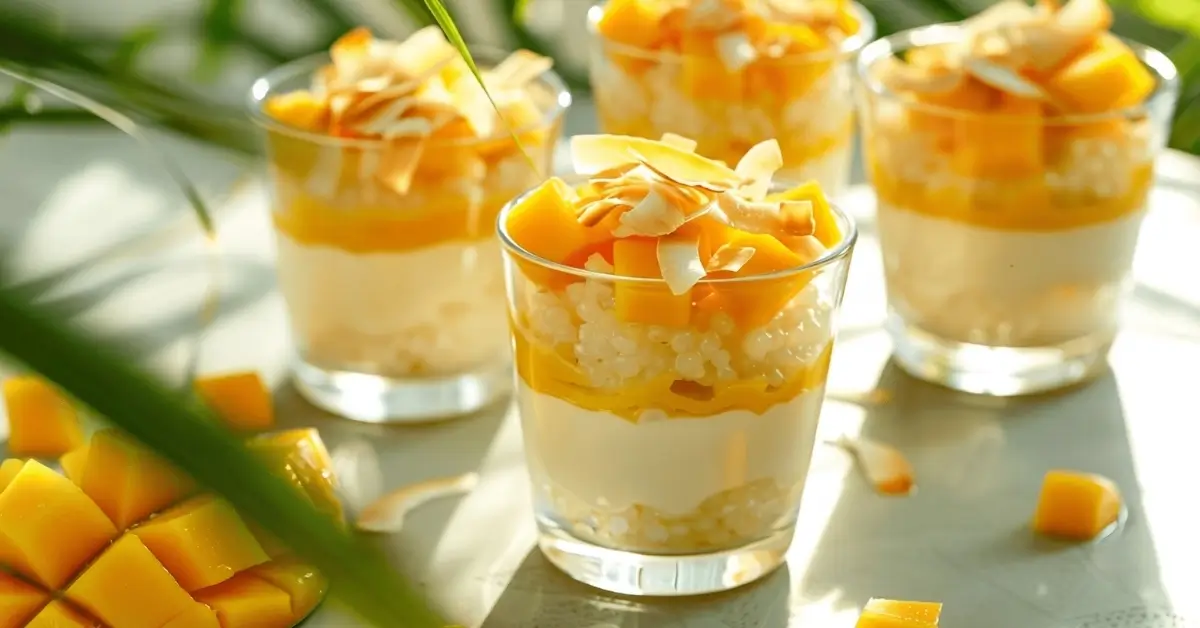
Ingredients
Main Ingredients
- 2 cups ripe mango chunks – about 2 large mangoes, peeled and pitted.
- 1/2 cup whole milk – adds creaminess and helps create a smooth pudding base.
- 1/2 cup heavy cream – gives the dessert a rich, silky texture.
- 1/4 cup granulated sugar – adjust slightly depending on the sweetness of your mangoes.
- 1 tablespoon fresh lime juice – brightens the mango flavor.
- 1 teaspoon unflavored powdered gelatin – helps the pudding set.
- 2 tablespoons cold water – used to bloom the gelatin.
- 1/2 teaspoon pure vanilla extract – adds a soft background sweetness.
- 1 small pinch salt – balances the overall flavor.
Optional Ingredients
- 1/4 cup diced fresh mango for topping.
- 2 tablespoons sweetened shredded coconut.
- Fresh mint leaves for garnish.
- 2 tablespoons toasted coconut flakes.
- 1 tablespoon chopped pistachios.
- Fresh berries for serving.
Ingredient Substitutions
- Fresh mango substitute: Use 2 cups thawed frozen mango chunks. Drain excess liquid before blending.
- Whole milk substitute: Use 2% milk for a slightly lighter pudding.
- Heavy cream substitute: Use canned full-fat coconut milk for a more tropical flavor.
- Granulated sugar substitute: Use an equal amount of fine cane sugar. Honey can also work, but it may slightly change the flavor and texture.
- Lime juice substitute: Fresh lemon juice works in the same amount.
- Gelatin substitute: A plant-based setting agent such as agar can be used, but it is not a direct 1:1 replacement and requires different heating instructions.
Equipment Needed
- Measuring cups.
- Measuring spoons.
- Sharp kitchen knife.
- Cutting board.
- Vegetable peeler, optional.
- Blender or food processor.
- Small mixing bowl.
- Small saucepan.
- Whisk.
- Silicone spatula or wooden spoon.
- Fine-mesh strainer, optional but recommended.
- Large mixing bowl.
- 6 small dessert cups, ramekins, or serving glasses.
- Ladle or measuring cup with a pouring spout.
- Plastic wrap or reusable food covers.
- Refrigerator.
Step-by-Step Instructions
Step 1: Prepare the Mangoes
Peel the mangoes and carefully slice the flesh away from the pits. Cut the fruit into chunks until you have approximately 2 packed cups.
Place the mango chunks in a blender or food processor.
The mango flesh should look deep yellow or orange, juicy, and soft rather than pale and firm.
Do not use underripe mangoes. Firm, sour fruit can make the finished pudding taste flat even after extra sugar is added.
Step 2: Blend the Mango Puree
Add the 1 tablespoon lime juice to the blender with the mango chunks. Blend for 30 to 60 seconds, stopping once if necessary to scrape down the sides.
Continue blending until completely smooth.
The puree should look thick, glossy, and mostly free of visible fruit pieces.
If your mangoes are fibrous, press the puree through a fine-mesh strainer before continuing. This extra step takes only a few minutes and creates a smoother dessert.
Step 3: Bloom the Gelatin
Pour 2 tablespoons cold water into a small bowl. Sprinkle 1 teaspoon unflavored powdered gelatin evenly over the surface.
Let it sit undisturbed for 5 minutes.
This process is called blooming. It allows the gelatin granules to absorb water before they are dissolved into the warm mixture.
The gelatin should look swollen, thick, and slightly jelly-like.
Do not dump dry gelatin directly into hot milk. It can form stubborn lumps that are difficult to whisk out.
Step 4: Warm the Milk and Sugar
Pour 1/2 cup whole milk into a small saucepan. Add the 1/4 cup granulated sugar and a pinch of salt.
Set the pan over low heat. Whisk gently for about 3 to 5 minutes, or until the sugar has completely dissolved.
Keep the mixture around 160°F to 170°F if checking with an instant-read thermometer.
The milk should be hot and lightly steaming, but it should not bubble aggressively or boil.
Boiling the milk can affect the smooth texture and may cause a cooked dairy flavor.
Step 5: Dissolve the Gelatin
Remove the saucepan from the heat. Add the bloomed gelatin immediately.
Whisk for 30 to 60 seconds, making sure the gelatin completely dissolves.
Rub a tiny drop of the mixture between two clean fingers after it cools slightly. It should feel smooth rather than grainy.
If you still see gelatin particles, continue whisking while the mixture is warm. Do not return it to a hard boil.
Step 6: Add the Heavy Cream and Vanilla
Whisk 1/2 cup heavy cream and 1/2 teaspoon vanilla extract into the warm milk mixture.
Mix gently until evenly combined.
Allow the mixture to cool for about 5 minutes. It can remain slightly warm, but it should not be extremely hot when combined with the fresh mango puree.
Step 7: Combine With the Mango Puree
Pour the creamy milk mixture into a large mixing bowl. Add the prepared mango puree.
Whisk slowly until the color and texture are completely uniform.
The mixture should look creamy, smooth, and evenly golden-orange with no white streaks.
Avoid aggressive whisking. Too much air can create foam and bubbles on top of the finished pudding.
Step 8: Taste and Adjust
Taste a small spoonful before portioning the pudding.
If your mangoes were slightly tart, you can add a little extra sugar, but dissolve it first in a tablespoon of warm milk. Avoid stirring coarse sugar directly into the finished mixture because it may remain gritty.
For a brighter flavor, add up to 1 additional teaspoon of lime juice.
Step 9: Strain for an Extra-Smooth Texture
For a restaurant-style finish, pour the entire pudding mixture through a fine-mesh strainer into a clean bowl or large measuring cup.
This step is optional, but it removes small mango fibers and any undissolved gelatin particles.
The strained mixture should pour smoothly and have a glossy appearance.
Step 10: Fill the Serving Cups
Divide the mango mixture evenly among 6 small dessert cups or ramekins.
Each serving should contain approximately 1/2 cup, depending on the exact amount of mango puree produced.
Tap each cup gently on the counter once or twice to release trapped air bubbles.
If foam appears on top, skim it away carefully with a spoon.
Step 11: Chill Until Set
Cover the dessert cups and refrigerate at 40°F or below for at least 4 hours.
For the most reliable texture, chill the pudding for 6 hours or overnight.
The center should look set and gently jiggle when the cup is moved. It should not look watery or slosh around.
Do not freeze the pudding to speed up setting. Freezing can damage the creamy texture and cause separation after thawing.
Step 12: Garnish and Serve
Remove the chilled pudding from the refrigerator just before serving.
Top with diced fresh mango, toasted coconut, mint leaves, berries, or chopped pistachios if desired.
Serve cold.
Let the pudding remain chilled until dessert time. The creamy texture is at its best when served straight from the refrigerator.
Nutrition Facts
Cost To Make This Recipe
Item – Estimated Cost (USD).
2 large ripe mangoes – $3.00.
Whole milk – $0.25.
Heavy cream – $1.25.
Granulated sugar – $0.15.
Fresh lime juice – $0.30.
Unflavored gelatin – $0.35.
Vanilla extract – $0.20.
Salt – $0.02.
Estimated Total Recipe Cost
Approximately $5.52 USD.
Estimated Cost Per Serving
Approximately $0.92 USD per serving.


